

Kiro
Kiro is an agentic IDE from AWS that turns prompts into executable specs, then implements them with parallel AI agents. It supports spec-driven development, property-based tests, model choice across Claude, GPT and open-weight models, and runs as an IDE, CLI, or cloud session for developers and teams.
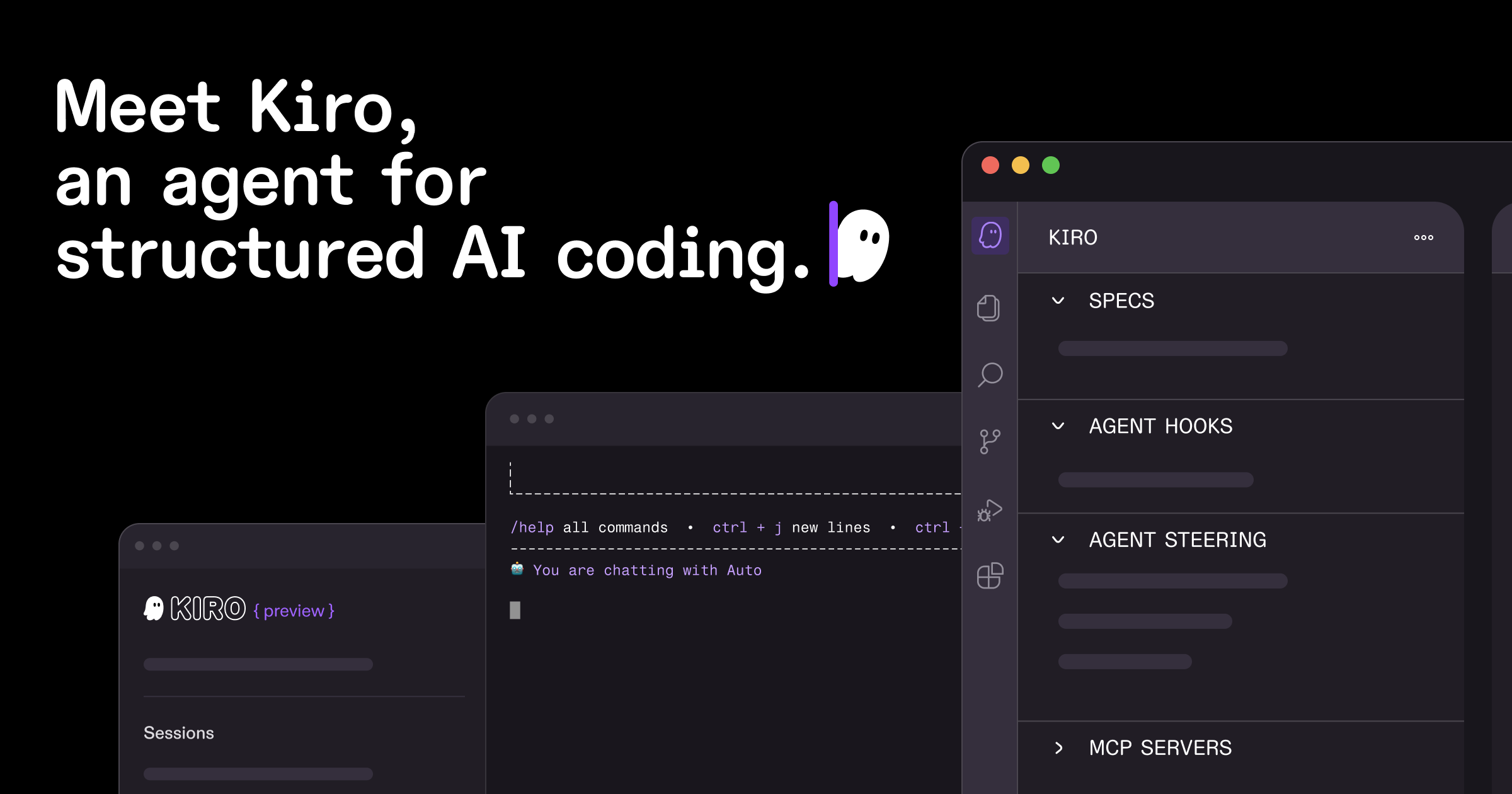
About Kiro
Overview
Kiro is an agentic IDE built and operated by AWS that aims to move developers beyond AI coding toward "agentic engineering." Instead of only generating code from prompts, Kiro turns prompts into requirements, architectural designs, and sequenced tasks, then implements them with parallel agents. It is available as an IDE, a CLI, and cloud sessions.
Key Features
- Spec-driven development: Converts prompts into executable specs covering requirements, design, and tasks before code is written.
- Correctness checks: Reviews requirements for contradictions and gaps using automated reasoning, and validates behavior with property-based tests that assert rules across all inputs.
- Parallel agents: Implements work on your local machine or in the cloud, with agents that learn from every session.
- Model choice: Select from Anthropic Claude, OpenAI GPT, open-weight models such as DeepSeek and Qwen, or an Auto option that picks a model based on task complexity, quality, latency, and cost.
- Headless CLI: Run Kiro in CI/CD to review pull requests and fix bugs without opening an editor.
- Open standards and compatibility: Supports the Agent Client Protocol (ACP), AGENTS.md, Skills.md, and MCP; the IDE supports Open VSX extensions, themes, and VS Code settings.
- Context from external tools: Pull context from tools such as Figma or Terraform.
- Enterprise-ready: IAM and SSO authentication, usage dashboards, cost management controls, IP indemnity with model exclusions, and governance and administration controls.
Use Cases
- Turning product requirements into structured specs and maintainable implementations.
- Catching edge cases that pass unit tests but fail in production.
- Automating PR reviews and bug fixes in CI/CD pipelines.
- Working across large codebases with parallel agents.
- Building cloud and infrastructure projects with Terraform and Python.
Pricing
Kiro uses a credit-based pricing model with no daily or weekly rate limits and pre-paid overages. A free tier includes 50 credits with access to open-weight models and Claude Sonnet 4.5. Paid plans are billed monthly: Pro at $20/month (1,000 credits), Pro+ at $40/month (2,000 credits), Pro Max at $100/month (5,000 credits), and Power at $200/month (10,000 credits), with add-on credits available at $0.04 per credit.
Who It Is For
Kiro is aimed at individual developers, startups, and enterprise engineering teams who want more structure and correctness in AI-assisted software development, from prototype to production.