8 Services Directory Websites to Find the Right Service Provider in 202
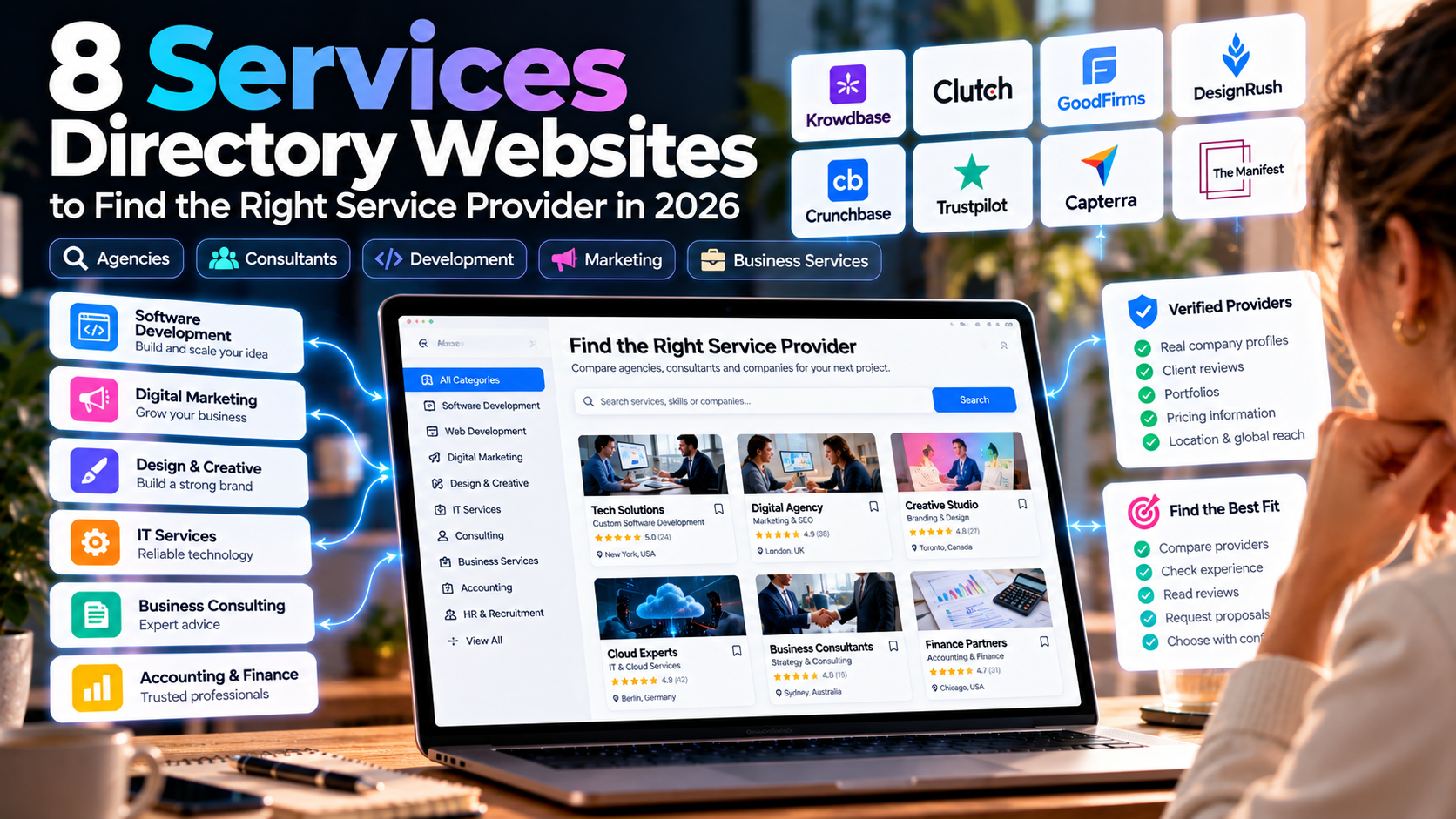
8 Services Directory Websites to Find the Right Service Provider in 2026
Finding the right company to handle a business project can be surprisingly difficult. Whether you need a software development team, digital marketing agency, IT consultant, web designer, accounting firm, or another professional service, a standard search engine can quickly produce hundreds of potential providers.
The challenge is not simply finding companies. It is identifying providers with the right expertise, experience, pricing, location, team structure, and track record for your particular project.
Services directory websites can make this process more structured. These platforms organize providers into categories and often include company profiles, customer reviews, portfolios, pricing information, locations, industries, and other details that can help businesses build a shortlist.
In this guide, we look at eight services directory websites that can be useful when researching agencies, technology companies, consultants, and other business service providers.
8 Services Directory Websites to Explore in 2026
| Platform | Main Focus |
|---|---|
| Krowdbase | Software, services, agencies, and technology providers |
| Clutch | B2B agencies and technology companies |
| GoodFirms | Service providers and technology companies |
| DesignRush | Creative, marketing, design, and technology agencies |
| Crunchbase | Company research and business information |
| Trustpilot | Customer reviews and company reputation |
| Capterra | Software and SaaS comparison |
| The Manifest | B2B companies and professional services |
What Is a Services Directory Website?
A services directory website is an online platform that organizes companies or professionals according to the services they provide.
Depending on the platform, you may find providers specializing in:
- Software development
- Website development
- Mobile app development
- Digital marketing
- SEO
- Branding and graphic design
- IT consulting
- Cybersecurity
- Business consulting
- Accounting
- Recruitment
- Ecommerce development
- Cloud services
- Outsourcing
- Software implementation
The main benefit is organization. Instead of starting with an unstructured list of search results, businesses can explore providers according to specific categories and requirements.
Many directories also allow users to filter companies by location, industry, company size, project budget, expertise, ratings, or other criteria.
1. Krowdbase
Main focus: Software, services, agencies, and technology providers.
Krowdbase combines software discovery with service-provider research, making it relevant when a business is still defining the type of solution it needs.
For example, a company looking to improve its online presence may need to compare several possible approaches, including website development, SEO, digital marketing, ecommerce development, or software solutions.
A structured directory can help turn a general business requirement into a more specific search.
Depending on the listing, businesses may be able to review information such as:
- Services offered
- Product or company descriptions
- Features
- Pricing information
- Industry focus
- Integrations
- Company information
- Reviews and ratings
- Alternatives
- Portfolio or visual material
This type of platform can be particularly useful during the early research stage, before contacting potential providers.
2. Clutch
Main focus: B2B agencies and technology providers.
Clutch is widely used for researching companies that provide business and technology services. Its categories cover areas such as software development, web development, digital marketing, design, IT services, consulting, and outsourcing.
Provider profiles can include information about services, locations, team size, project budgets, hourly rates, portfolios, industries, and customer reviews.
Clutch can be useful when a company has already identified the type of service it needs and wants to compare several potential providers.
However, directory information should be treated as a starting point. A company should still verify recent projects, technical expertise, availability, and pricing before signing a contract.
3. GoodFirms
Main focus: Service providers and technology companies.
GoodFirms provides business listings covering software development companies, marketing agencies, IT providers, design firms, consultants, and other technology-related businesses.
Businesses can use the platform to explore providers by service category, location, expertise, company profile, portfolio, team size, and customer feedback.
This can be particularly useful when researching providers in different geographic markets or when considering remote and international teams.
As with any directory, information should be verified directly with the provider. Team composition, pricing, availability, and service offerings can change over time.
4. DesignRush
Main focus: Creative, branding, marketing, design, and technology agencies.
DesignRush focuses heavily on agencies and creative service providers. Its categories include branding, web design, digital marketing, advertising, graphic design, video production, app development, software development, and IT services.
It can be useful for companies searching for providers such as:
- Branding agencies
- Web design companies
- Digital marketing agencies
- UX and UI teams
- Video production companies
- Ecommerce agencies
- App development companies
- Public relations firms
When evaluating creative providers, the portfolio deserves particular attention. A strong visual presentation does not necessarily mean that an agency has experience with your industry, target audience, or business model.
5. Crunchbase
Main focus: Company research and business intelligence.
Crunchbase is different from a traditional services directory. Its primary purpose is researching companies and their business background rather than simply finding service providers.
It can provide useful information about areas such as company history, leadership, funding, investors, acquisitions, industries, and business relationships.
This information can become valuable after creating an initial shortlist. For example, a company evaluating a technology provider may want to understand the provider's background, business development, or funding history.
Crunchbase should therefore be viewed as a complementary research resource rather than a replacement for a service-provider directory.
6. Trustpilot
Main focus: Customer reviews and company reputation.
Trustpilot takes a different approach by focusing primarily on customer feedback and public reviews.
It can help businesses investigate how companies handle areas such as:
- Customer service
- Billing
- Refunds
- Communication
- Delivery
- Complaints
- Technical support
Reviews can provide useful context, but star ratings alone should not determine a purchasing decision.
Look at the actual written feedback, especially recent reviews. Repeated complaints, recurring positive themes, and the company's responses can provide more useful information than an overall rating.
7. Capterra
Main focus: Software and SaaS discovery.
Capterra is primarily a software discovery and comparison platform rather than a general services directory.
Businesses can use it to investigate categories including:
- CRM software
- Accounting software
- Project management software
- HR software
- Payroll software
- Customer service software
- Inventory management
- Scheduling software
- Marketing software
It becomes particularly relevant when the project involves selecting a software platform rather than hiring a traditional service provider.
There can also be an overlap between software and services. A company purchasing a new CRM, ERP, or ecommerce platform may also need implementation, migration, customization, or consulting services.
8. The Manifest
Main focus: B2B companies and professional services.
The Manifest provides company listings across several business-service categories, including development, marketing, design, IT, consulting, staffing, finance, logistics, and customer support.
It can help businesses understand which types of providers are available for a particular project and identify companies operating in different markets.
Potential categories include:
- Software development
- Web development
- App development
- SEO
- Digital marketing
- Branding
- IT services
- Business consulting
- Staffing
- Accounting services
As always, company profiles should be treated as an initial research source rather than the final basis for selecting a provider.
How to Choose the Right Service Provider
Finding potential providers is only the beginning. The next step is determining whether a company is actually suitable for your project.
1. Define the business objective
Start with the problem you want to solve rather than the name of a company you think might solve it.
Your objective could be to:
- Generate more qualified leads
- Build an ecommerce website
- Automate repetitive processes
- Launch a mobile application
- Improve customer support
- Replace outdated software
- Increase search visibility
- Improve internal operations
A clearly defined objective makes it much easier to identify the appropriate service category.
2. Define the project scope
Before contacting providers, prepare a basic description of the project.
Include information such as required features, integrations, expected deliverables, target launch date, support requirements, and ongoing maintenance.
The more clearly the scope is defined, the easier it becomes to compare proposals from different providers.
3. Look for relevant experience
A provider may offer exactly the service you need and still be a poor fit for your project.
Review whether the company has experience with businesses similar to yours in terms of:
- Industry
- Company size
- Technology
- Target audience
- Budget
- Project complexity
Relevant experience is often more valuable than a long list of generic services.
4. Understand who will do the work
Ask about the actual team assigned to the project. Determine who will manage the relationship, perform the technical work, handle design, and provide support.
This is particularly important when a provider relies on freelancers, subcontractors, or external teams.
5. Request a detailed proposal
A serious proposal should clearly describe the scope of work, deliverables, timeline, pricing, payment schedule, revision process, support, and responsibilities of both parties.
Avoid comparing providers using only a headline price. Two companies can quote very different amounts while offering substantially different scopes of work.
6. Check post-project support
Some projects require ongoing assistance after launch. Before signing an agreement, ask about maintenance, technical support, updates, training, bug fixes, monitoring, and future improvements.
The initial project may be only one part of the overall cost and relationship.
Common Mistakes When Using Service Directories
Choosing only by rating
A high rating does not automatically mean that a provider is appropriate for your specific project. Read the underlying reviews and look for evidence of relevant experience.
Choosing the cheapest option
The lowest quote may exclude important deliverables, support, maintenance, or other services. Compare the complete scope rather than the starting price alone.
Contacting too many providers
Researching dozens of companies can create unnecessary noise. A focused shortlist of around three to five relevant providers is often easier to manage.
Ignoring communication
The sales process can reveal how a provider communicates. Slow responses, unclear answers, or poor organization may become bigger problems once the project starts.
Forgetting ownership
For development, design, content, and marketing projects, clarify who owns the final files, source code, accounts, data, domains, and intellectual property.
Relying on outdated profiles
Company profiles can become outdated. Always confirm current services, pricing, team structure, availability, and recent portfolio work directly with the provider.
How to Use Services Directories More Effectively
The most efficient approach is to use directories as research tools rather than as decision-making systems.
- Define the business problem.
- Identify the relevant service category.
- Research several providers.
- Compare experience and capabilities.
- Review customer feedback.
- Create a shortlist of three to five companies.
- Request detailed proposals.
- Check references and recent work.
- Compare the complete cost and scope.
- Verify contract and ownership terms before signing.
This process reduces the risk of selecting a provider simply because it appears near the top of a directory or has an attractive profile.
Services Directories Are the Starting Point, Not the Final Decision
Services directory websites can significantly reduce the amount of time required to discover potential providers. They bring companies into organized categories and make it easier to compare basic information before beginning direct conversations.
Different platforms are useful for different stages of research. Some specialize in agencies and technology companies, others focus on software, company information, or customer reviews.
The most effective approach is to combine directory research with your own due diligence. Define the project first, create a focused shortlist, investigate relevant experience, request detailed proposals, and verify important information directly with each provider.
When used this way, services directories become a practical first step toward finding the right agency, consultant, technology company, or professional service provider for a business project.