

MiniMax
MiniMax is a Shanghai-based AI company with its own family of models for video (Hailuo), voice and speech, images and text. Creators can make short AI video clips and expressive, multilingual voiceovers with voice cloning and voice design. Developers get a pay-as-you-go API, and some models have open weights. Keep in mind that the service is run from China.
Is MiniMax right for you?
Best for: Creators and small marketing teams who need short AI video clips and natural, multilingual voiceovers on a modest budget, plus developers who want to add MiniMax's video, speech and language models to their own apps through a pay-as-you-go API.
Pros
- Hailuo and H3 video models span quality-first, high-speed and low-cost Lite tiers
- Speech 2.8 voices come in HD and cheaper Turbo versions with fine controls
- Voice Design creates reusable voices from text; voice cloning is also available
- Speech-to-text includes speaker labels and SRT/VTT subtitle export
- Low per-unit API prices, plus open-weight models on Hugging Face and GitHub
Cons
- Run by a China-based company, so review data-handling terms before uploading sensitive material
- Users often report inconsistent video results that need several attempts and use up credits quickly
- Users mention queues at busy times on lower plans and moderation that blocks harmless prompts
- Consumer apps, agent tools and the API live in separate places, and model names change often
For creators, MiniMax's real strengths are video and voice. The Hailuo/H3 video line produces convincing motion at fair prices, and the Speech 2.8 voices, with voice design and cloning, sound natural across many languages. The trade-off is that this is a Chinese AI model platform, which some organizations won't accept for client or personal data, and video generation still takes retries and some patience at busy times. We'd recommend it to marketers, YouTubers and indie studios producing social clips and narration, and to developers comparing low-cost model APIs, as long as the data-residency question is settled first.
About MiniMax
MiniMax is a Chinese AI company that builds its own models for video, voice, images and text, and sells them through consumer apps and a pay-as-you-go developer API. If you know the Hailuo video generator, you already know part of MiniMax: Hailuo is its video model line. The company is based in Shanghai and was founded in late 2021. That matters for some readers, and we come back to it in the limits section.
We think MiniMax makes the most sense for two groups. The first is creators who need short AI video clips and natural-sounding voiceovers without paying top-tier prices. The second is developers who want to plug those same video, speech and language models into their own apps through an API. If you've ever made a product teaser on a deadline and then spent another hour hunting for a narrator voice that didn't sound robotic, this is the kind of problem MiniMax targets.
The four model families, and how they fit together
MiniMax doesn't feel like one app. It's closer to a toolbox of models sharing one account and one billing system. On its homepage the company groups the current flagships into language, video, image and speech. For creators, video and speech are the stars.
Video: the Hailuo line and the H3 series
The video models turn a text prompt or a still image into a short clip. The current H3 series comes in several flavors. The standard H3 puts quality first. H3-Highspeed balances quality and speed for everyday content. H3-Lite is the cheap option for exploring ideas and batch runs. H3-Max accepts image, video and audio references in a single task, which helps when you want a clip built from several assets. Older Hailuo models such as Hailuo 2.3 and Hailuo-02 are still available as legacy options. For example, you can upload a product photo, describe a slow camera push-in, and get back a few seconds of motion you can drop into a social ad.
Speech and voice
Speech 2.8 is the text-to-speech model, offered in an HD version and a faster, cheaper Turbo version. You get controls for volume, pitch, speed and mixing. There's also an async mode for long-form narration of up to 1 million characters per request. Voice Design lets you describe a voice in plain words, something like "warm, middle-aged narrator with a slight British accent", and get a reusable voice ID. MiniMax is also known for voice cloning, so you can build a voice from your own samples. On the other side of the pipeline, speech-to-text transcribes audio with speaker labels and exports subtitles as SRT or VTT.
Images
H3 Image generates pictures from text and edits existing images using one or more reference images. It can output up to 4K, and MiniMax describes it as an open-weight model. An optional prompt-enhancement step can expand a short prompt into a fuller description before generation.
Language models and agents
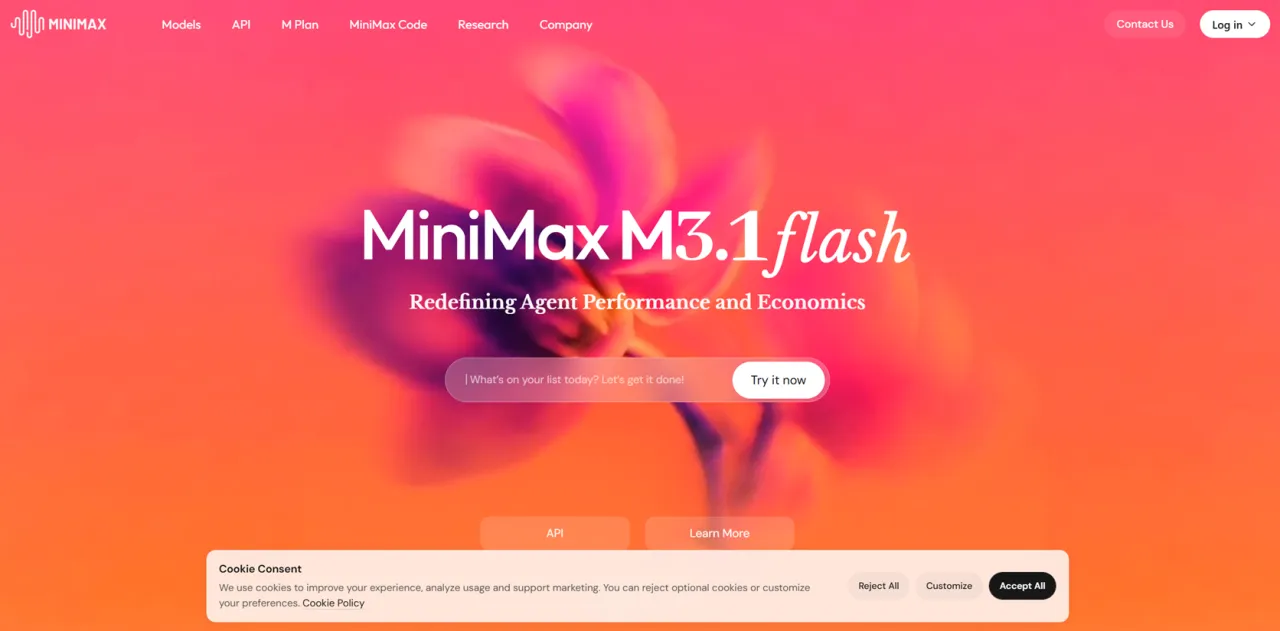
The M3 and M3.1 Flash language models handle chat, writing, coding and agent-style tasks. MiniMax pitches M3.1 Flash specifically on agent performance and cost. On top of these models, the company offers products such as MiniMax Code and MiniMax Design, plus a general-purpose agent built around its own models. For most creators these are a side dish. For developers they're the cheapest way into the platform.
Your first session, step by step
- Go to the official MiniMax website and decide which door you need: a consumer product (like the Hailuo video app or the agent) or the API platform for developers.
- Sign up for an account. If you're building something, open the API platform, add a payment method and create an API key.
- Start with one model family. Creators should try a short video or a text-to-speech sample first. Developers can hit the M3.1 Flash endpoint with a test prompt.
- Open the pricing overview in the docs before running anything big. Every model has its own unit (tokens, characters, seconds of video, images), so check what one run will cost.
- For voice work, try the HD and Turbo speech models on the same paragraph and compare before you commit to one.
- Save the prompts and settings that work. You'll reuse them more often than you expect.
A real example: a 10-second product teaser with a voiceover
Picture a small coffee brand that needs a teaser for a new cold brew. The marketer has one good product photo and a two-line script. First, they upload the photo to an image-to-video model and write a prompt like this:
A glass bottle of cold brew on a wooden café counter, morning sunlight through the window, slow camera push-in, condensation dripping down the glass, shallow depth of field, calm and cozy mood.
They usually run it two or three times and keep the clip with the cleanest motion. Next, they paste the script into Speech 2.8 HD, pick (or design) a relaxed, friendly voice, and nudge the speed down a little so it fits the clip. They download the audio, line both up in their usual video editor, add the logo, and export a vertical cut for social. The whole thing takes an afternoon instead of a shoot day. If the brand later wants the same voice for every ad, a designed or cloned voice keeps the series consistent.
More ways people use MiniMax
- YouTubers and podcasters: Generate narration for explainers, or transcribe interviews with speaker labels and export SRT subtitles in one pass.
- Social media managers: Turn still product shots into short motion clips for Reels and TikTok without booking a videographer.
- Game and app studios: Use Voice Design to prototype character voices from text descriptions before hiring voice actors.
- Audiobook and e-learning teams: Use async long-form synthesis to narrate full chapters or course modules in one request.
- Developers on a budget: Build chatbots or agents on M3.1 Flash, where the price per token is low compared with many big-name models.
- Researchers and tinkerers: Download the open-weight models from MiniMax's Hugging Face and GitHub pages and run them on your own hardware.
Tips for better results
- Describe camera movement explicitly. Video prompts that say "slow pan left" or "static shot" usually behave better than vague mood words alone.
- Prototype on the cheap tiers. Test ideas on H3-Lite or Highspeed, then render the final version on the quality model.
- Budget for retries. Assume you'll generate a few versions of each clip and pick the best. Plan your credits or API spend around that.
- Use Turbo for drafts and HD for the final. The voices share the same controls, so you can switch at the end without rewriting anything.
- Write voice descriptions like a casting call. Age, accent, energy and pace give Voice Design much more to work with than "nice voice".
- Keep reference images clean. Well-lit images of a single subject give image editing and video models less to misread.
Limits and things to watch out for
The biggest one first: MiniMax is a company based in China. If you work with client material, personal data or anything under strict data-handling rules, read its privacy terms carefully and talk to your legal or IT team before uploading sensitive files. For many personal and marketing projects this won't be a dealbreaker. For some organizations it will be.
Generation results also vary from run to run, especially in video. Faces, hands and fast motion can still go wrong, so budget time for retries. Content filters may also block prompts that seem harmless, and rewording usually helps.
Finally, the platform is wide but a bit scattered. Consumer apps, the agent, the audio tools and the API live in different places, and model names change quickly (the Hailuo branding now sits next to the newer H3 names). Expect a short orientation period.
What users say about MiniMax
Many users praise the Hailuo video models for realistic motion and good value, and the voices come up again and again as expressive and natural across many languages. Voice cloning gets frequent mentions too. Developers like the low API prices and the fact that some models ship with open weights. Several people also point out that having text, voice, music and video in one place saves juggling accounts, and that free credits for new users make it easy to try.
The complaints are just as consistent. A common one is queues and slow generations at busy times, especially on lower plans. Users also say results can be inconsistent, so a usable clip often takes several attempts, and credits run out fast with heavy use. Some report that moderation blocks harmless prompts. Others raise privacy concerns because the service is run by a company based in China.
What it costs, in plain words
On the API platform, MiniMax uses pay-as-you-go billing, and each model has its own unit. A few examples from the pricing overview: M3.1 Flash is listed at $0.15 for input and $0.60 for output in its token table. Speech 2.8 HD costs $100 per million characters and Turbo costs $60. Speech-to-text costs $0.38 per hour of audio, and Voice Design costs $3 per voice. A 1K text-to-image generation with H3 Image runs about $0.022, and the older image-01 model is $0.0035 per image. Legacy Hailuo 2.3 video is listed at $0.28 for a 6-second 768P clip. Some models carry permanent or limited-time discounts, so check the live page before you budget.
Hobbyists and creators will usually be happier in the consumer apps, which work with credits and plans. Their current terms are on the official site. Developers and teams with steady volume should use the API, where you pay only for what you generate.
Alternatives worth a look
If voice is your main need and you want a polished studio with dubbing and a big voice library, ElevenLabs is the obvious comparison. For cinematic AI video with a dedicated creative studio, Kling AI plays in the same league as Hailuo. Developers who mainly want a cheap, capable language model API can also compare DeepSeek. Note that DeepSeek is also run from China, so it doesn't solve the data-location question.
Our take
MiniMax is one of the more interesting all-round model makers right now. The video and voice models are strong for the price, and the API is straightforward once you find your way around. Creators who want natural voiceovers and quick motion clips should give it a real try. Anyone handling sensitive data should weigh where the company is based before going all in.
Features
Available On
MiniMax FAQ
What is MiniMax used for?
MiniMax is a China-based AI company that offers its own models for video (the Hailuo and H3 lines), speech and voice, images and text. Creators mostly use it for short AI video clips and voiceovers, while developers access the same models through its API platform.
Is MiniMax free?
The API uses pay-as-you-go billing, so you pay per token, character, image or second of video. Users report that new accounts get free credits to try the tools, and some models are released with open weights that you can run yourself.
How much does MiniMax text-to-speech cost?
On the API, Speech 2.8 HD is listed at $100 per million characters and Speech 2.8 Turbo at $60 per million characters. Voice Design costs $3 per voice, and speech-to-text costs $0.38 per hour of audio.
Does MiniMax have an API?
Yes. The MiniMax Open Platform provides API access to its language, video, image and speech models, with documentation and per-model pricing on platform.minimax.io.