Perplexity AI Review: Features, Deep Research, Pricing and Limitations
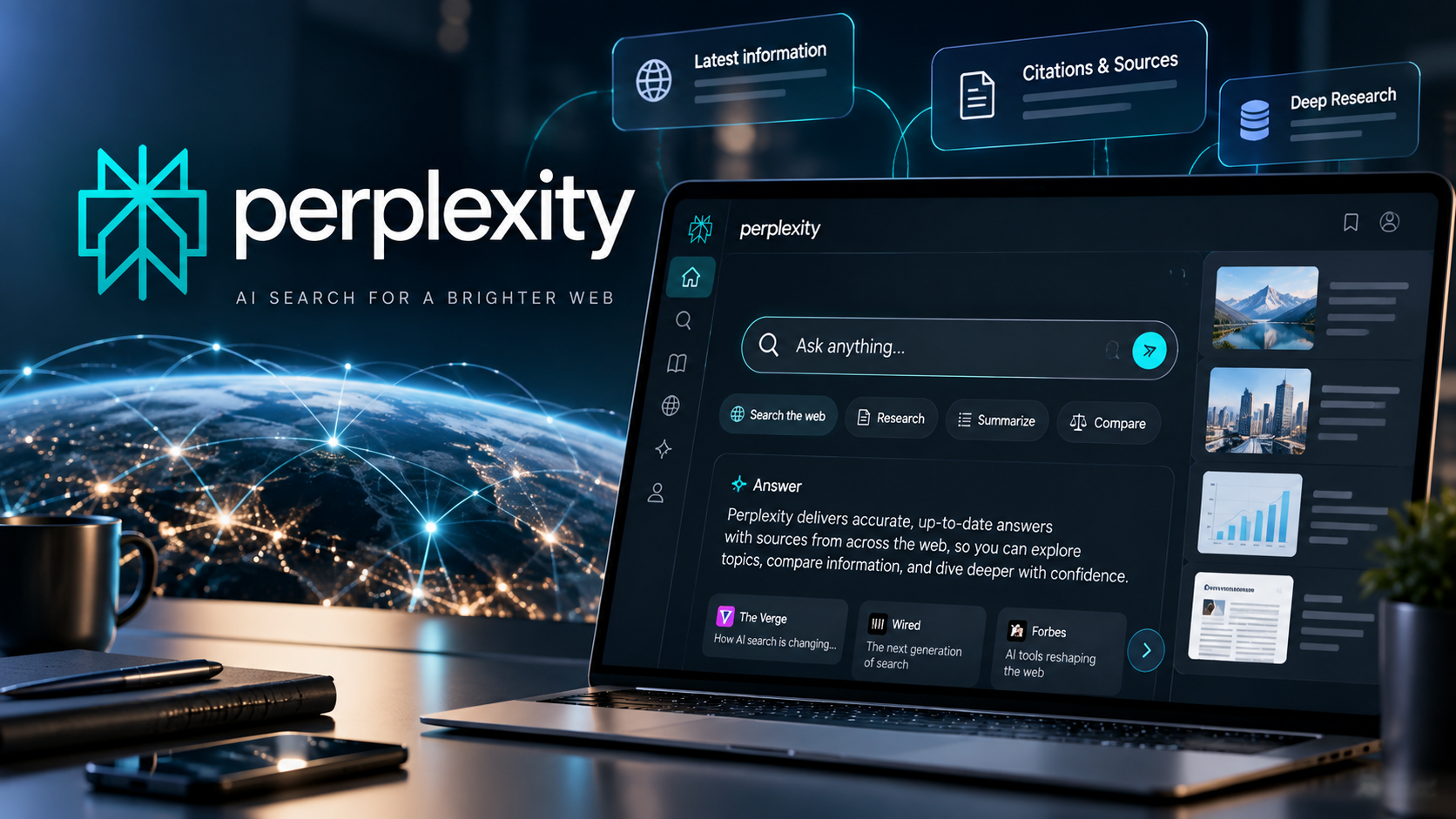
Artificial intelligence has changed how people search for information, but finding a reliable answer still requires more than generating fluent text. Users need current information, useful context, and sources they can check. Perplexity AI addresses this need by combining AI-generated answers with web search and source citations.
Rather than presenting only a conventional list of search results, Perplexity synthesizes information from relevant sources into a structured response. Users can then open the cited pages, ask follow-up questions, compare information, and continue researching within the same conversation.
In this guide, we examine how Perplexity works, what its main features can do, how Deep Research differs from ordinary search, which tasks the platform is suited for, and where its limitations matter. You can also explore the tool on AITevon’s Perplexity AI page.
What Is Perplexity AI?
Perplexity AI is an AI-powered answer engine designed to help users find, understand, and investigate information. It combines search capabilities with language models that interpret questions, retrieve relevant material, and produce readable answers supported by references.
This approach sits between a traditional search engine and a conversational AI assistant. A traditional search engine primarily helps users discover web pages. A general-purpose chatbot can generate explanations and content, but its answers may not always be grounded in current online sources. Perplexity emphasizes connecting its responses to information that users can inspect.
The platform is useful for questions involving recent developments, product comparisons, background research, technical explanations, and topics that require consulting multiple sources. Depending on the selected mode, account, and subscription, users may also have access to advanced research, file analysis, model selection, and content-generation features.
How Does Perplexity AI Work?
Perplexity typically follows a research-oriented workflow. The exact process depends on the question and the search mode, but it can be understood through several stages.
1. Understanding the question
The system interprets the user's request to identify the topic, the information required, and any constraints. A broad question may benefit from clarification or a more specific follow-up prompt.
2. Retrieving relevant information
When web search is enabled, Perplexity retrieves relevant material from online sources. Depending on the selected mode, the research may focus on general websites, academic material, financial information, or files supplied by the user.
3. Synthesizing the results
An AI model processes the retrieved information and generates a structured response. It may combine findings from several pages, explain relationships between concepts, summarize evidence, or identify differences between competing claims.
4. Providing citations
Perplexity presents source links alongside its answers so users can inspect the underlying material. These citations improve traceability, but they do not automatically guarantee that every statement is correct or that every source fully supports the associated claim.
5. Continuing the investigation
Users can ask follow-up questions to narrow the topic, request additional evidence, compare alternatives, or explore a specific source in greater detail. This conversational workflow makes it possible to move from a general question to a more focused investigation without restarting each search.
Key Features of Perplexity AI
AI Search With Source Citations
The central feature is its ability to combine search results into a direct answer. Instead of requiring users to open numerous pages before understanding a topic, Perplexity provides an initial synthesis and links to supporting sources.
This is particularly useful when researching unfamiliar subjects, comparing products, checking recent developments, or gathering background information before making a decision.
However, citations should be treated as a starting point for verification. A linked page may provide only partial support for a statement, contain outdated information, or represent one perspective among several.
Pro Search
Pro Search is designed for questions that require more than a quick response. It can investigate a topic through multiple searches, synthesize a wider range of sources, and produce a more detailed answer.
It is useful for requests such as comparing competing technologies, investigating a business market, explaining a complex technical subject, or identifying arguments on different sides of a debate.
Access and usage limits depend on the current subscription plan. Users should consult the official Pro Search documentation for current details.
Deep Research
Deep Research is intended for complex questions that benefit from a structured, multi-step investigation. Rather than simply answering a question in a single pass, it can develop a research approach, investigate multiple aspects of a topic, evaluate sources, and assemble the findings into a comprehensive report.
Potential applications include market research, technology assessments, competitive analysis, academic background research, and detailed comparisons. Depending on the available features, research results may also be transformed into other deliverables.
Deep Research is different from a standard search because the objective is not merely to provide a quick answer. It is to build a more extensive synthesis of evidence. Nevertheless, the depth of a report does not remove the need to check its important claims, assumptions, and sources.
Model Selection
Some Perplexity plans allow users to select among supported AI models. This can be helpful when different tasks require different strengths, such as detailed reasoning, concise explanations, coding assistance, or document analysis.
Model availability changes over time and varies by plan. The presence of a particular model should therefore be verified in the current interface rather than assumed from older reviews.
File Uploads and Document Analysis
Where supported, users can upload documents and ask Perplexity to summarize them, extract key points, compare information, or answer questions about their contents.
For example, a researcher might upload a PDF report and ask for its main conclusions, a developer might provide a technical document and request an explanation, or a business user might analyze a spreadsheet to identify trends.
File analysis depends on the file format, document quality, account limits, and the capabilities available in the selected mode. Scanned documents, complicated tables, charts, and ambiguous passages may not always be interpreted correctly.
Projects and Organized Research
Perplexity provides ways to organize related conversations and research around projects. Depending on the current interface and plan, projects can help users keep relevant threads and files together and maintain context across an ongoing investigation.
This is useful for recurring work such as monitoring an industry, researching a product category, preparing a report, or collecting background information for a longer project.
Users should check sharing and access settings before adding sensitive files to a shared workspace.
Image and Video Generation
Eligible paid plans may include access to image or video generation features. These capabilities extend the platform beyond information retrieval and can support visual exploration, concept development, and selected creative tasks.
Availability, model choices, output limits, and supported formats can change. Users who specifically need image or video production should verify the current plan details before subscribing.
Practical Ways to Use Perplexity AI
Researching a Topic
Perplexity can help users build an initial understanding of a subject by gathering relevant information and identifying useful sources. It can also help formulate more precise questions for further investigation.
For example, instead of asking only for a general overview of renewable energy, a user could request a comparison of solar and wind energy costs, the factors affecting those costs, and links to recent authoritative studies.
Comparing Products and Services
Users can request side-by-side comparisons of software, devices, subscriptions, and online services. A well-structured query should specify the criteria that matter, such as price, compatibility, features, limitations, or intended use.
Because product information and pricing change, important details should be checked against current official pages before purchasing.
Academic and Educational Research
Students and educators can use Perplexity to explore unfamiliar subjects, locate potentially relevant research, summarize concepts, and develop a reading list.
It should support learning rather than replace it. Users need to read the original sources, check quotations and references, and follow their institution's rules for AI-assisted work.
Market and Competitor Research
Entrepreneurs, marketers, and analysts can use the platform to investigate competitors, emerging trends, customer segments, and changes in an industry.
For meaningful analysis, prompts should define the market, geographical scope, time period, and comparison criteria. Conclusions should be validated against primary sources and reliable data, especially when financial or strategic decisions depend on them.
Technical Learning and Coding
Perplexity can help explain programming concepts, locate documentation, investigate error messages, and compare technical approaches. It can be useful during the early stages of debugging or when learning an unfamiliar framework.
However, a cited answer is not proof that a code sample is secure, compatible, or correct. Developers should test generated code, consult official documentation, and review security implications before using it in production.
Summarizing Documents
When file analysis is available, Perplexity can help extract key points from reports, identify themes across documents, and answer questions about supplied material.
For high-stakes documents, verify important numbers, legal wording, technical specifications, and conclusions against the original files.
How to Get Better Results From Perplexity
The quality of an AI-assisted search depends partly on how clearly the task is described. Specific instructions make it easier to obtain a response that fits the intended purpose.
Define the objective
Explain whether you need a quick factual answer, a comparison, a list of sources, a technical explanation, or a comprehensive research report.
Provide context and constraints
Specify the relevant time period, region, audience, technical level, budget, or other conditions. If the question concerns current information, explicitly request recent sources.
Ask for evidence
Request primary sources where possible, distinguish established facts from estimates, and ask the system to identify uncertainty or conflicting evidence.
Specify the output format
Tell Perplexity whether you need a concise summary, a comparison table, a step-by-step explanation, a list of sources, or a structured report.
Verify the important claims
Open the citations, check publication dates, and compare claims with authoritative sources. This is particularly important for legal, medical, financial, scientific, and rapidly changing information.
Example Perplexity Prompts
The following examples illustrate how to formulate useful research requests.
Market Research
Analyze the current market for AI-powered writing tools. Compare five established products by target audience, key features, pricing model, and limitations. Use current official product pages where possible, cite each important claim, and clearly mark information that cannot be verified.
Technology Comparison
Compare Laravel and Django for building a data-driven web application. Explain their architectures, ecosystem, security considerations, deployment requirements, and typical use cases. Present a comparison table and link to official documentation.
Academic Research
Research the main applications and limitations of retrieval-augmented generation in enterprise systems. Prioritize peer-reviewed papers and primary technical sources, summarize the evidence, and distinguish experimental results from established production practices.
Document Analysis
Analyze the attached report. Summarize its principal findings, identify the most important numerical results, list the assumptions behind its conclusions, and point out any claims that require additional evidence. Do not invent information that is absent from the document.
Perplexity AI Pricing: Free vs. Paid Plans
Perplexity offers a free plan and paid subscriptions with expanded access to features and usage. The precise limits and available tools can change, so the current official pricing page should be consulted before making a purchasing decision.
Free Plan
The free plan is suitable for users who primarily need everyday searches and cited answers. It provides an accessible way to test the service and determine whether its research workflow fits their needs. Some advanced searches, models, uploads, and creation features may be limited or unavailable.
Perplexity Pro
Pro is intended for people who use the platform more frequently or need expanded research capabilities. Depending on the current offering, it can include increased access to advanced searches, supported AI models, file analysis, and image or video generation.
The official pricing page lists Pro at $20 per month at the time of this review. Prices, taxes, billing options, and included usage may vary by location or change over time.
Perplexity Max and Business Plans
Higher-tier individual and enterprise plans are designed for heavier usage or organizational requirements. Depending on the plan, these may provide higher limits, advanced features, administrative controls, collaboration options, or additional privacy commitments.
These plans are not necessary for every user. Their value depends on actual usage, the importance of advanced features, and the organization's security and collaboration requirements.
For current details, consult Perplexity's official pricing page and its subscription plan guide.
Advantages of Perplexity AI
- Source-linked answers: Citations make it easier to trace claims to the pages used in a response.
- Efficient information discovery: The platform can combine material from several sources into one readable summary.
- Follow-up questions: Users can refine a search without repeatedly starting from scratch.
- Research-oriented workflows: Advanced search and research modes support more complex investigations.
- Multiple use cases: The platform can assist with education, market research, technical learning, and document analysis.
- Flexible access: A free plan allows users to evaluate the basic experience before considering a paid subscription.
Limitations of Perplexity AI
Citations Do Not Guarantee Accuracy
A response can include links and still contain an incorrect interpretation, an unsupported statement, or a misleading synthesis. Users should confirm that the cited sources actually support the claims being made.
Source Quality Varies
Search results may include outdated pages, promotional content, incomplete reporting, or sources with conflicting conclusions. For important research, prioritize original documents, official documentation, peer-reviewed studies, and other authoritative material.
Information May Be Incomplete
Not every relevant source will necessarily be found or considered. A response can omit important counterarguments, regional differences, or recent developments, especially when the question is broad or the evidence is fragmented.
Advanced Features Have Limits
Access to advanced search, models, uploads, and generation features may depend on the subscription plan and current usage limits. Users should not assume that every advertised capability is unlimited or available in every account.
Generated Content Requires Review
Summaries, reports, tables, and generated code can contain mistakes. They should be reviewed before publication, deployment, or use in decisions with significant consequences.
It Does Not Replace Professional Judgment
Perplexity can help users understand complex topics, but it should not be treated as a substitute for qualified medical, legal, financial, or other professional advice when the consequences of an error are significant.
Privacy and Data Considerations
Before using any AI research platform, consider what information you submit and which privacy terms apply to your account. Queries, uploaded files, and generated content may be processed to provide the service, subject to the applicable policies and settings.
Perplexity's consumer privacy notice describes its data practices and user choices. Business and API offerings may operate under different terms and commitments. Users handling confidential business information should review the specific agreement and plan documentation rather than assuming that consumer and enterprise protections are identical.
A sensible approach is to avoid uploading passwords, credentials, unnecessary personal information, confidential client records, or sensitive company documents unless the relevant service has been approved for that use.
Read the official Perplexity Privacy Notice for further details.
Perplexity AI vs. Traditional Search Engines
Traditional search engines are effective when users want to discover many pages, navigate to a known website, or compare original sources themselves. Perplexity is designed to add a synthesized answer to the search process.
The difference is not that one approach is always better. For a simple navigational query, a traditional search engine may be faster. For a question that requires combining information from several sources, an AI-generated synthesis may save time. In both cases, users should consult original sources when accuracy matters.
Who Should Use Perplexity AI?
- Students and educators: To explore topics, identify sources, and clarify difficult concepts.
- Researchers: To gather initial evidence and organize investigations before examining primary sources in depth.
- Entrepreneurs and marketers: To investigate markets, products, competitors, and industry developments.
- Developers: To discover documentation, understand technical concepts, and investigate coding problems.
- Professionals: To summarize documents, compare information, and prepare preliminary reports.
- Everyday users: To get contextual answers to questions that benefit from supporting references.
Is Perplexity AI Worth Using?
Perplexity AI is particularly useful for people who regularly research unfamiliar topics and want answers connected to sources they can inspect. Its combination of search, synthesis, citations, and follow-up questions can make information discovery more efficient.
Its value depends on the task. It is not automatically more accurate than every traditional search engine or AI assistant, and the quality of its output depends on source coverage, question wording, model behavior, and verification by the user.
The free plan is a reasonable starting point for occasional searches. Users who frequently conduct complex investigations or need expanded tools can compare the paid plans against their actual requirements.
To explore the platform and its main use cases, visit Perplexity AI on AITevon or go directly to the official Perplexity website.
Frequently Asked Questions About Perplexity AI
What is Perplexity AI used for?
Perplexity AI is used to search for information, generate source-linked answers, investigate complex topics, compare products and services, summarize documents, and support research workflows.
Is Perplexity AI free?
Yes. Perplexity offers a free plan for everyday search, with limits on some advanced capabilities. Paid plans provide expanded access to selected features and higher usage limits.
Does Perplexity AI provide sources?
Perplexity presents citations and links with its answers to help users inspect the underlying material. Citations should still be checked to confirm that the sources support the claims.
What is the difference between Pro Search and Deep Research?
Pro Search is intended for more detailed answers to complex questions. Deep Research focuses on a more extensive, multi-step investigation that can produce a structured report. Availability and limits depend on the current plan and product offering.
Can Perplexity analyze PDF files?
Supported accounts and modes can accept PDFs and other file types for analysis. Available formats, file limits, and usage allowances may vary. Users should verify important extracted information against the original document.
Can Perplexity write code?
It can explain code, help investigate errors, and generate coding examples. Generated code should be tested and reviewed for correctness, compatibility, and security before it is used in production.
Is Perplexity AI always accurate?
No. It can misunderstand sources, omit important evidence, or generate incorrect conclusions. Users should verify important claims, especially in high-stakes situations.
Is Perplexity AI suitable for professional research?
It can support professional research by gathering information and synthesizing sources. It should be used as an aid rather than as the sole basis for major business, legal, financial, or scientific decisions.
How much does Perplexity Pro cost?
The official pricing page lists Pro at $20 per month at the time of writing. Check the current official pricing page for updated prices, billing options, and included features.
Where can I learn more about Perplexity AI?
Visit the official Perplexity website for the service, or explore the Perplexity AI listing on AITevon for additional tool information.