Leonardo AI Review: Features, Image Generation, Video Tools and Pricing
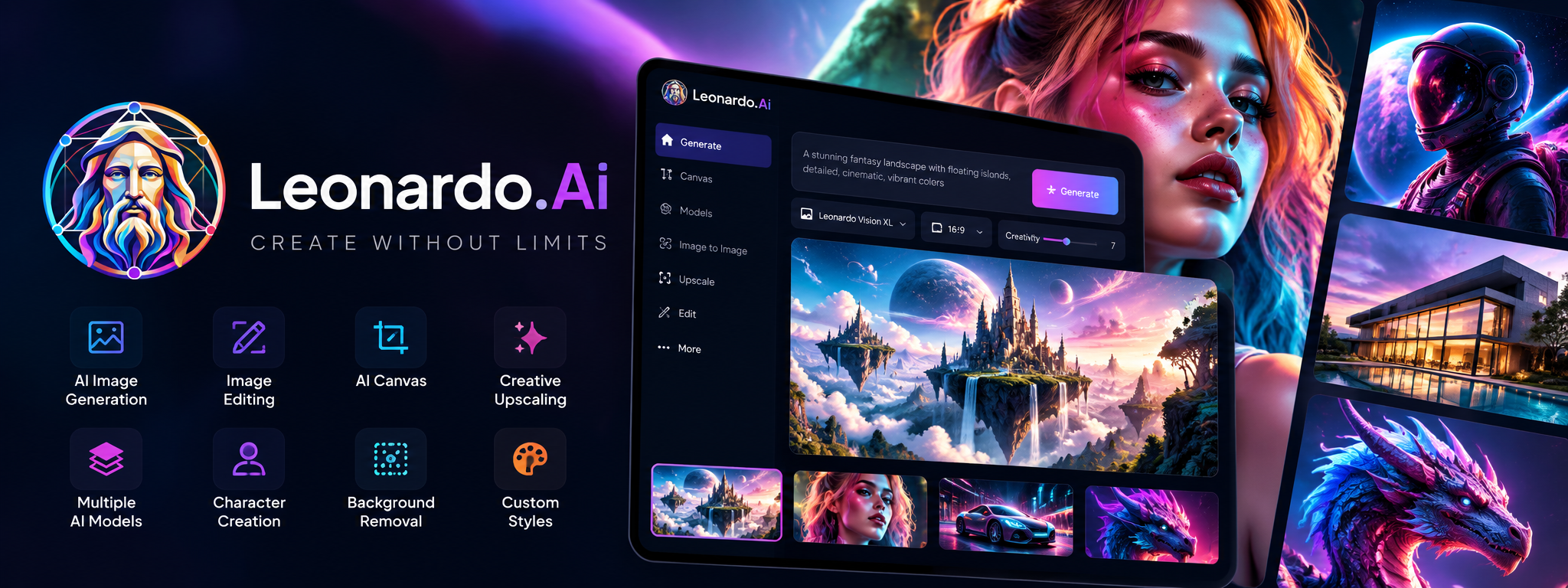
Leonardo AI Review: Features, Image Generation, Video Tools and Pricing
AI image generators have evolved from simple text-to-image systems into creative platforms that support ideation, image editing, visual consistency, and video production. Leonardo.Ai is one of the platforms built around this broader workflow. It brings multiple generative models and creative tools into one environment, allowing users to create visual assets from text prompts, refine existing images, and experiment with motion.
In this in-depth Leonardo AI review, we examine how the platform works, its main features, practical use cases, pricing structure, advantages, limitations, and the privacy and commercial-use questions creators should understand before using it. You can also visit the Leonardo AI tool page on AITevon for a concise overview and related information.
What Is Leonardo.Ai?
Leonardo.Ai is a cloud-based generative AI platform focused on visual content. Its tools support image generation, image editing and enhancement, and AI video workflows. Instead of relying on a single model for every task, the platform provides access to different models and generation modes, so users can choose an approach that better fits a particular visual style or production goal.
This makes Leonardo useful for digital artists, designers, marketers, content creators, game developers, illustrators, and small businesses that need original visual concepts without building every asset from scratch. It can help with early-stage brainstorming as well as the production of more polished images, although the amount of manual refinement required depends on the brief and output.
How Does Leonardo AI Work?
Leonardo uses generative models to interpret text instructions and, where supported, image inputs. The prompt describes the subject, setting, composition, visual style, lighting, mood, and other details. The selected model generates an output based on those instructions and its learned patterns.
- Define the objective. Decide whether you need a product image, character concept, illustration, marketing visual, background, or video clip.
- Write a specific prompt. Describe the main subject, environment, composition, lighting, perspective, style, and desired level of detail.
- Choose a model and settings. Different models can produce different strengths and visual characteristics.
- Generate and compare variations. Review the results rather than assuming the first output will be final.
- Refine the image. Adjust the prompt, use available editing or image-guidance tools, and regenerate where necessary.
- Export and review. Check visual defects, text accuracy, brand consistency, and usage rights before publishing.
Prompt quality matters, but it is not the only factor. Model selection, aspect ratio, guidance settings, input images, and generation limits can also affect the result. For an overview of the tool, see the Leonardo.Ai listing on AITevon.
Leonardo AI Main Features
1. Text-to-Image Generation
The central use case is creating images from natural-language prompts. Users can describe a scene, character, object, product concept, environment, or illustration and generate visual alternatives. This can support concept art, editorial illustrations, social media graphics, campaign ideas, mood boards, presentation visuals, and early product mock-ups. Results vary by model and prompt, and generated images should be inspected for unwanted details or inconsistencies.
2. Multiple Image Models and Styles
Leonardo provides access to different image-generation models. Models are not interchangeable: some may be better suited to photorealistic scenes, others to stylized illustrations, controlled compositions, or particular editing tasks. Test a small number of models against the same prompt and compare composition, detail, style, and prompt adherence. Model availability and capabilities can change, so check the current model selector and documentation.
3. Image-to-Image and Reference-Guided Workflows
Where supported by the selected model and tool, users can provide an existing image or visual reference to guide a new generation. These workflows are useful for exploring variations or developing a consistent visual direction, but they do not guarantee exact reproduction. Only upload images you have permission to use, particularly if they contain client work, confidential material, or identifiable people.
4. Image Editing and Enhancement
Leonardo's workflow extends beyond initial generation. Depending on current tool availability, users can edit existing images, make targeted changes, improve resolution, or refine assets for different uses. AI editing can still alter nearby areas or introduce artifacts, so compare the result with the original and perform a quality check before publishing.
5. AI Video Generation
Leonardo offers AI video workflows that let users experiment with motion and turn visual ideas into short clips. Depending on the currently available models, a workflow may begin with a text prompt or image. Models can differ in motion quality, prompt adherence, duration, speed, and audio support. Video generation can help with storyboards, social concepts, product mood pieces, and early advertising drafts, but motion continuity, faces, object consistency, and fine details may require multiple iterations.
6. Personal Models and Consistent Visual Direction
Leonardo has offered tools for training or using personal AI models on eligible plans, subject to current availability and limits. Personalization can help develop a more consistent visual direction across a collection of assets. Review the platform's rules and ensure you have rights to any training or reference material you provide.
7. API for Developers
Leonardo provides an API for integrating image and media generation into applications and production workflows. Developers should evaluate authentication, usage limits, concurrency, latency, cost controls, and applicable API terms before deployment. API usage and consumer subscriptions may have different rules. See the official Leonardo API page for technical details.
Practical Use Cases for Leonardo AI
Digital Art and Concept Design
Artists can explore character silhouettes, environments, props, costumes, color palettes, and alternative compositions. It accelerates ideation, but a coherent final design may still require manual drawing, compositing, and art direction.
Marketing and Social Media
Marketing teams can develop campaign concepts, background images, visual variations, and creative drafts for social posts. Before using generated assets in a live campaign, check brand requirements, typography, product accuracy, and rights associated with uploaded references.
Game Development
Game developers and independent studios can explore characters, environments, props, and mood boards during pre-production. Establish clear review and licensing procedures before incorporating generated assets into a shipped game.
Product Concepts and E-commerce
Designers can explore packaging, product styling, scene composition, and advertising directions. AI-generated product visuals should not misrepresent the actual product; verify dimensions, features, and colors rather than relying on imaginative generation.
Blogging, Publishing, and Presentations
Bloggers and publishers can create illustrations, article headers, and supporting visual concepts. Define a consistent visual style and ensure images remain relevant to the text. Avoid visuals that mislead readers about real people, events, or evidence.
Storyboards and Short Video Concepts
Creators can explore scenes, framing, visual tone, and motion ideas before investing in full production. Treat outputs as drafts when continuity, exact timing, or precise control over actors and objects is important.
How to Write Better Leonardo AI Prompts
A useful prompt gives the model concrete visual information instead of relying on vague requests such as “make something beautiful.” Include the subject, setting, composition, lighting, camera or perspective, style, mood, and intended use where relevant.
Example prompt for a product image:
A premium matte-black wireless headphone displayed on a clean stone pedestal, minimalist studio set, soft directional lighting from the upper left, subtle reflections, neutral charcoal background, three-quarter product view, crisp material texture, realistic commercial product photography, balanced negative space, no added text or logos.
Example prompt for a fantasy environment:
An ancient observatory built into a mountain above a sea of clouds, enormous brass instruments and weathered stone arches, sunrise breaking through distant mist, cinematic wide composition, atmospheric perspective, intricate environmental details, muted teal and amber palette, high-end fantasy concept art.
Change one or two prompt elements at a time so you can understand which instructions affect the output. If text must be exact, such as a product label or logo, verify it manually and consider adding typography in a dedicated design tool.
Leonardo AI Pricing: Free and Paid Plans
Leonardo has offered a free plan and several paid subscriptions, with access and limits based on tokens, generation speed, privacy controls, model availability, and other features. The official pricing page currently lists the following individual plans; prices and allowances can change, and taxes may be added at checkout.
- Free: $0 per month, with a daily allowance of fast tokens and public creations.
- Essential: a paid entry-level option for more frequent use, with a larger token allowance and private creation access.
- Premium: a higher allowance and additional generation capacity for more active creators.
- Ultimate: a larger token allocation and expanded capacity, including relaxed generation for selected image and video models.
At the time of review, the official pricing page showed monthly-equivalent prices of approximately $12 for Essential, $30 for Premium, and $60 for Ultimate. Verify current prices, billing options, and included limits on the official Leonardo.Ai pricing page before subscribing.
Many generation tasks consume tokens, and the amount can depend on the model, output settings, and type of generation. Some paid plans include relaxed generation for selected models after fast tokens are used, but “unlimited” does not necessarily mean every model, mode, or workflow is unlimited. Read plan details if you expect to generate large volumes of images or videos.
Privacy, Ownership, and Commercial Use
Privacy and usage rights matter when generated assets are intended for client work, marketing, products, or commercial publication. Rules can differ between free and paid subscriptions, public and private generations, and the consumer platform and API.
Free Plan: Public Creations
Leonardo's current terms state that, for free subscribers, intellectual property rights in generated outputs vest in Leonardo.Ai as between the parties, subject to applicable law and the terms. Free creations are public by default and may be visible to other users. A free account should therefore not be treated as a private workspace for confidential concepts or exclusive assets.
Paid Plans: Private Content and Ownership
Under Leonardo's terms, paid subscribers generally receive ownership of intellectual property rights in content they create, subject to compliance with the terms and applicable law. Paid subscribers can choose whether content is public or private. Private content is intended to be accessible only to the account holder and authorized users, while public content is made available to others under the platform's terms. For confidential projects, check visibility settings before generating.
Can Leonardo AI Images Be Used Commercially?
Commercial use depends on the current terms, subscription or API arrangement, content itself, rights to uploaded input, and applicable law. Leonardo's guidance has stated that free-plan creations may be used commercially, but they are public and ownership is treated differently from paid outputs. Users remain responsible for avoiding infringement of trademarks, copyrights, publicity rights, and other third-party rights.
This is a practical summary, not legal advice. Before selling or licensing an asset, read the current Leonardo.Ai Terms of Service and Privacy Policy. Do not upload confidential client material or copyrighted references unless you have the necessary permissions and understand how the service will process them.
Advantages of Leonardo AI
- Broad creative workflow: image generation, editing, enhancement, and video tools in one platform.
- Model choice: compare models and select those suited to a particular style or task.
- Useful for ideation: rapid variations help teams explore visual directions.
- Multiple skill levels: beginners can start with prompts, while experienced creators can refine workflows with advanced controls.
- Developer integration: API access can support applications and automated media workflows.
- Free entry point: users can test the platform before paying, subject to current limits and public-creation rules.
Limitations and Things to Consider
- Token limits and cost: frequent generation, high-quality outputs, and video workflows can consume allowances quickly.
- Variable results: prompts may produce inconsistent details, anatomy, object relationships, or composition.
- Learning curve: multiple models and controls can make choosing the right setup difficult for beginners.
- Privacy differences: free creations are public by default, which may be unsuitable for confidential projects.
- Commercial rights require attention: rights depend on plan terms, visibility settings, inputs, and applicable law.
- Rapid product changes: models, pricing, and token rules can change.
- Human review remains necessary: generated assets may need editing, factual verification, accessibility checks, and quality control.
Leonardo AI vs. Other AI Image Generators
Leonardo is worth considering when you want a platform that combines image creation with editing and video workflows, plus a selection of models. No single generator is best for every use case. Some tools may be preferable for a particular illustration style, typography, design workflow, integration, or level of control.
Compare platforms using the same test prompts and evaluate prompt adherence, image quality, editing controls, consistency, privacy, commercial terms, output limits, and total cost. A visually impressive sample is not enough to determine whether a tool will fit a repeatable production workflow.
Explore the Leonardo AI listing on AITevon to continue researching the tool.
Who Should Use Leonardo AI?
Leonardo can suit digital artists, designers, game developers, marketing teams, bloggers, and creators who need to explore or produce visual assets regularly. It is particularly useful when rapid iteration and access to several image or video models matter more than relying on a single fixed workflow.
It may be less suitable for users who need guaranteed pixel-perfect control, predictable results without review, or a private workspace while using a free account. Businesses with strict confidentiality or licensing requirements should evaluate the terms and controls before adopting the platform for production.
Frequently Asked Questions About Leonardo AI
Is Leonardo AI free?
Leonardo offers a free plan with a limited daily allowance. Free-plan creations are public by default, and ownership terms differ from paid subscriptions. Check the official pricing page for current limits.
Can Leonardo AI generate videos?
Yes. Leonardo provides AI video generation workflows, with model options and limits that can vary over time and by subscription. Review the current interface and pricing details for supported models and allowances.
Can I use Leonardo AI images for commercial projects?
Commercial use is addressed in Leonardo's terms and guidance, but ownership and privacy provisions differ between free and paid users. Ensure your prompts, uploaded references, and final outputs do not violate third-party rights, and check the current terms before commercial use.
Are Leonardo AI generations private?
Free-plan creations are public by default. Paid subscribers can choose private content, subject to the platform's current settings and terms. Check visibility controls before generating sensitive or client-related material.
Does Leonardo AI offer an API?
Yes. Leonardo offers an API for developers who want to integrate image or media generation into applications. API access, pricing, limits, and privacy terms may differ from consumer subscriptions.
Is Leonardo AI suitable for beginners?
Beginners can start by entering a text prompt and reviewing generated variations. Advanced controls and model selection take time to learn, so begin with simple prompts and change one variable at a time.
What are the main alternatives to Leonardo AI?
Alternatives vary according to the task, such as photorealistic images, illustration, design, or video generation. Compare tools using the same prompts and assess output quality, editing features, privacy, commercial terms, and total cost.
Final Verdict: Is Leonardo AI Worth Trying?
Leonardo.Ai is a versatile creative platform for generating and refining images and experimenting with AI video. Its combination of multiple models, editing workflows, and developer access can make it useful for individual creators and teams. Its practical value depends on the quality you need, the amount of iteration involved, and the limits of your chosen plan.
The most reliable way to evaluate Leonardo is to test it with a real task, compare several outputs, and calculate how much time and token usage are required to reach an acceptable result. Before using generated assets in commercial or confidential projects, verify the current terms, privacy settings, and rights associated with inputs and outputs.
For more details, visit the Leonardo AI page on AITevon and explore other AI tools in the AITevon directory.
Editorial note: Features, subscription prices, model availability, and usage rights may change. Always consult Leonardo.Ai's official website and terms for the latest information.