
What Is Agentic AI? How Autonomous Agents Actually Work
Agentic AI moves beyond chat: agents plan, call tools and finish multi-step work. Here is how single- and multi-agent systems are built, governed and adopted in 2026.
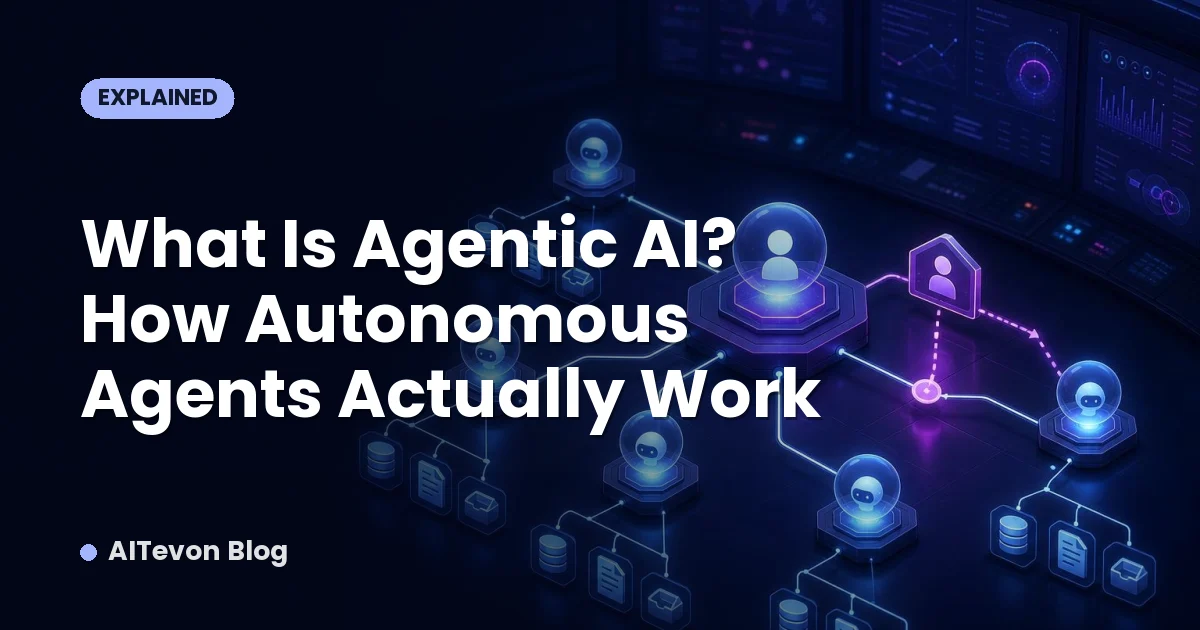
Most people still picture AI as a chat box that answers questions. Agentic AI is different: it is software that takes a goal, breaks it into steps, calls the tools it needs and keeps going until the job is done or a human steps in. Instead of drafting an email, it can look up the customer record, check inventory, file the ticket and log the outcome.
That shift matters because it changes what businesses buy and how teams measure results. Buyers now ask about reliability, integration, security and cost control as often as they ask about raw model quality. This article explains what agentic AI is, how autonomous multi-agent systems are designed, where they work today and what still blocks wider adoption.
Key Takeaways
- Agentic AI pairs an LLM with capabilities for planning, remembering context, calling tools and holding permissions, letting the system work toward an objective instead of replying to one request.
- Multi-agent designs split complex workflows across specialized agents managed by a supervisor, which reduces hallucinations and speeds up processing.
- Adoption is real but early: research firms put deployment in production well below the share of organizations still piloting.
- Open protocols such as MCP and agent-to-agent communication are replacing brittle custom integrations.
- Governance, identity controls and deterministic code for calculations are what separate demos from production systems.
What Agentic AI Actually Means
An agentic system wraps a foundation model in a loop. The model reads the situation, decides on the next action, uses a tool or API, inspects the result and repeats. Memory keeps context across long-running tasks, and a permission layer decides which systems the agent may touch and how much it may spend.
That makes it fundamentally different from two older categories. Robotic process automation follows fixed scripts and breaks when something unexpected happens. Chat assistants generate text but do not act. Agentic AI sits between them: flexible enough to handle variation, structured enough to be audited.
Market research firms describe the category in four layers that are now forming: foundation models for reasoning, orchestration frameworks that coordinate agents, enterprise applications that embed agents inside CRM, ERP and IT service tools, and a governance layer that manages access and cost. The governance layer is the newest addition, and its appearance in analyst frameworks signals that the category is maturing rather than just hyping.
Single-Agent vs. Multi-Agent Systems
Early deployments mostly used one general-purpose agent. Forecasts for 2026 still show single-agent architectures holding the larger share of the market, and that makes sense: one agent with a clear scope is easier to test and monitor.
Multi-agent systems become attractive when a workflow has distinct skills. A supervisor agent routes requests to specialists — one for intent extraction, one for database lookup, one for policy checks — each with a tightly scoped prompt and its own tools. Teams that tried this pattern in public build challenges cut processing time dramatically by running specialized agents in parallel instead of asking one large model to do everything at once.
Why splitting the work helps
- Fewer hallucinations: narrow prompts leave less room for the model to invent details.
- Easier maintenance: swapping a model or changing a schema touches one sub-agent, not the whole workflow.
- Better throughput: independent steps can run at the same time.
- Cleaner accountability: each agent's actions can be logged and reviewed separately.
The trade-off is coordination overhead. More agents mean more messages, more failure points and a harder debugging story, so start with one agent and split only where you can measure a gain.
How a Production Agent Is Built
The gap between a demo and a deployed agent is mostly engineering discipline. Practitioners who build these systems repeatedly point to a few patterns that hold up under pressure.
- Separate reasoning from execution. Let the model interpret intent and extract variables, then hand those variables to deterministic code. Asking a language model to calculate interest or move money directly invites errors; strict schemas validate the output before a normal function or SQL query runs.
- Design for replacement. The orchestration code you write today may be obsolete when a new model handles the same task natively. Keep components modular so you can retire glue code quickly.
- Treat multimodality as core. Agents that ingest images, documents and screenshots solve more real problems than text-only ones, especially in retail, support and document-heavy back offices.
- Adopt open protocols. Standards like the Model Context Protocol let agents discover tools and resources without custom wrappers for every system.
- Build observability in from day one. Trajectory-based testing, structured logs and interruptibility let you see what an agent did and stop it when needed.
Developers experimenting with these ideas can start on accessible models. Tools such as DeepSeek are popular for reasoning and coding work, while Gemini offers multimodal input that suits agents handling images and documents. Kimi has positioned its recent models around long-horizon agent tasks and large context windows, which matters when an agent must track a task across many steps.
The 2026 Market and Adoption Reality
Forecasts for the agentic AI market vary widely because each firm draws the boundary differently. Estimates for 2026 range from roughly USD 9 billion to more than USD 22 billion, with projected 2033 values anywhere from about USD 139 billion to USD 224 billion. Growth rates cluster in the high 30s to low 40s percent per year. Treat these numbers as directional, not precise, and expect revisions.
The adoption numbers paint a clearer picture. Studies referenced in industry reports show that only a small share of companies run agents in production, whereas a far bigger set is testing them or plans to launch within two years. What stands out about today's landscape is the gap separating intention from actual rollout, and the main constraints are data preparedness, integration workload and governance rather than what models can do.
Where agents are landing first
- Customer service and support, the largest application segment in current forecasts
- IT operations and software engineering, where tasks are bounded and measurable
- Sales operations and business intelligence
- Industry-specific work in life sciences, financial services and manufacturing
Bounded, repetitive workflows with clear success criteria convert fastest. Cross-functional processes that span many systems and approval chains remain early.
What Chinese Developers Are Pushing
Competition in China has moved from model size toward whether a model can turn reasoning into action. DeepSeek's research team has described an experimental "super-agent" architecture that monitors information continuously, runs tasks in parallel and acts with less supervision. The company framed it as an engineering exploration, not a shipped feature, but the internal version reportedly watches group chats for bug reports and tries to reproduce problems on its own.
Other releases point the same way. Moonshot AI's Kimi K3.1 Pro emphasizes coding, 3D creation and long-horizon agent tasks with a one-million-token context window. MiniMax says its M3.1 Flash cut the cost of agent tasks substantially while speeding up inference. Researchers at China's academy for information and communications technology note that agents are an engineering layer on top of language models, and that reliability, contextual memory and long-horizon execution still need work before mass adoption.
Risks, Costs and Governance
Giving software permission to act inside business systems raises questions that a chatbot never did. The main ones:
- Security: an agent with transaction rights needs identity controls, scoped credentials and monitoring.
- Accountability: when an agent makes a decision, someone must own the outcome and the audit trail.
- Cost: always-on agents consume inference continuously. If operating cost exceeds the value of the workflow, the business case collapses.
- Reliability: high-risk processes still need human approval gates and escalation paths.
A practical rule is to grant the smallest permission set that completes the task, log every tool call, and define a clear escalation trigger. Human oversight should be designed in, not bolted on after an incident.
FAQ
What is the difference between generative AI and agentic AI?
Generative AI produces content in response to a prompt. Agentic AI adds planning, memory, tools and permissions so the system can complete multi-step work across applications with limited human involvement.
Do I need a multi-agent system?
Not at first. Start with one agent on a bounded task, measure where it fails, and split into specialized agents only when a specific bottleneck justifies the extra coordination cost.
Are AI agents reliable enough for production?
For bounded tasks in support, IT operations and software engineering, yes, with guardrails. For long-horizon, cross-functional processes, most organizations are still in pilot mode.
What are MCP and A2A?
They are open protocols for agent interoperability. MCP lets agents discover and use tools and data sources in a standard way; agent-to-agent protocols let separate agents communicate across systems and organizations.
How much does agentic AI cost?
Pricing depends on model, volume and orchestration platform, and it changes often. Budget for inference, integration work and ongoing monitoring rather than a single license fee.
Where to Start
Agentic AI is best understood as a discipline, not a product. The winning pattern is consistent: scope one workflow with a measurable outcome, keep the model focused on reasoning, hand execution to deterministic code, connect tools through open protocols, and instrument everything so you can see what the agent did and stop it when it goes wrong.
From there, expand deliberately. Pick a task where handoffs and cycle time are visible costs, run it as a pilot with tight permissions, and compare results against the human baseline before scaling to a multi-agent design. The technology will keep changing; a governed, modular architecture is what lets you keep up.
Sources
- Agentic AI Market Report 2026- 2033, Application Type, Geo, Tech — MarketsandMarkets
- AI agents being given greater autonomy — China Daily
- Designing Multi-Agent Systems - How to build applications where multiple AI agents reliably collaborate to solve new types of complex tasks — Google Books
- Enterprise Agentic AI Market Report 2026 - Research and Markets — Research and Markets report
- Agentic AI Market Size, Share & Trends Analysis Report By Component By Application, By End Use, By Region, And Segment Forecasts, 2026 - 2033 - Compare — GII Research
- Build Better AI Agents: 5 Developer Tips from the Agent Bake-Off — Google for Developers Blog
- Agentic AI Market Outlook 2026–2033 | — Meticulous Research
- Agentic AI Market Size, Share & Forecast Report, 2034 - - Technology — Fortune Business Insights